
Hair Loss Runs in Your Family. Start Protecting Your Hair Now


November 9, 2026
Featuring Jordan R. Plews, PhD Kay Durairaj, MD, FACS,
and Rodney Sinclair, MD, MBBS
During a recent webinar with facial plastic surgeon Dr. Kay Durairaj, MD, FACS, Dr. Jordan Plews, PhD, a molecular biologist and scientific advisor to Revian, shared how he can trace hair loss on both sides of his family tree: “My father had 3 hair transplants, my mother’s father was bald, and her brother was bald. Genetically speaking, I should probably be bald by now”1
Dr. Plews’ story is common. Pattern hair loss, or androgenetic alopecia (AGA), can come from either parent and affects both women and men.2,3 Family history can’t predict exactly when thinning will start, but it gives you something most people never get: a head start.
Key Takeaways
- Pattern hair loss can be inherited from either side of the family.2,3
- By the time scalp is visible, hair density may already be about 50% lower.4
- Revian Red is FDA-cleared to treat pattern hair loss in a convenient 10-minute daily treatment.5
The Mirror Lies
In AGA, susceptible follicles gradually shrink, or miniaturize, producing finer, shorter hairs.8 This happens quietly. The Scalp often doesn’t become visible until the hair density has dropped about 50%.4 In other words, by the time you notice your hair is thinning, half the density may already be gone.
The first clue is often subtle. Dermatologist Rodney Sinclair and colleagues describe a “loss of volume in their pony tail without visible baldness.”8 If your hair feels thinner in your hand before it looks thinner in the mirror, treat that as a reason to act, not wait.
“Early diagnosis and initiation of treatment is desirable.”
Rodney Sinclair, MBBS, MD, dermatologist9
What to Do Now
- Get a baseline scalp assessment. Your health care provider can document your density while your hair still looks full, so future changes are measurable.3,8
- Ask about miniaturization. It’s the earliest sign of AGA and can be detected before thinning is obvious.8
- Start a routine you’ll actually keep. Consistency drives results with any hair growth treatment, and AGA is ongoing, so treatment is too.6,12
“…you want to get ahead of hair loss as early as you can.”
Jordan R. Plews, PhD, 1
How Revian Targets Inherited Hair Loss
Revian’s lightweight, hands-free, wireless cap pairs 620 nm red-orange light with 660 nm red light in a 10-minute daily treatment you can run while doing chores or watching TV.5
Laboratory research suggests this dual-wavelength combination increases nitric oxide, which inhibits 5-alpha reductase, the enzyme that converts testosterone into dihydrotestosterone (DHT).10 DHT is a well-established driver of follicle miniaturization in men; hormonal factors in women are more complex.9,11
In that cell-based study, the dual wavelengths reduced DHT production by 79%, compared with about 40% for finasteride, the leading drug for lowering DHT, in the same experiment. That’s roughly double the reduction, a standout result for a drug-free, at-home device.10
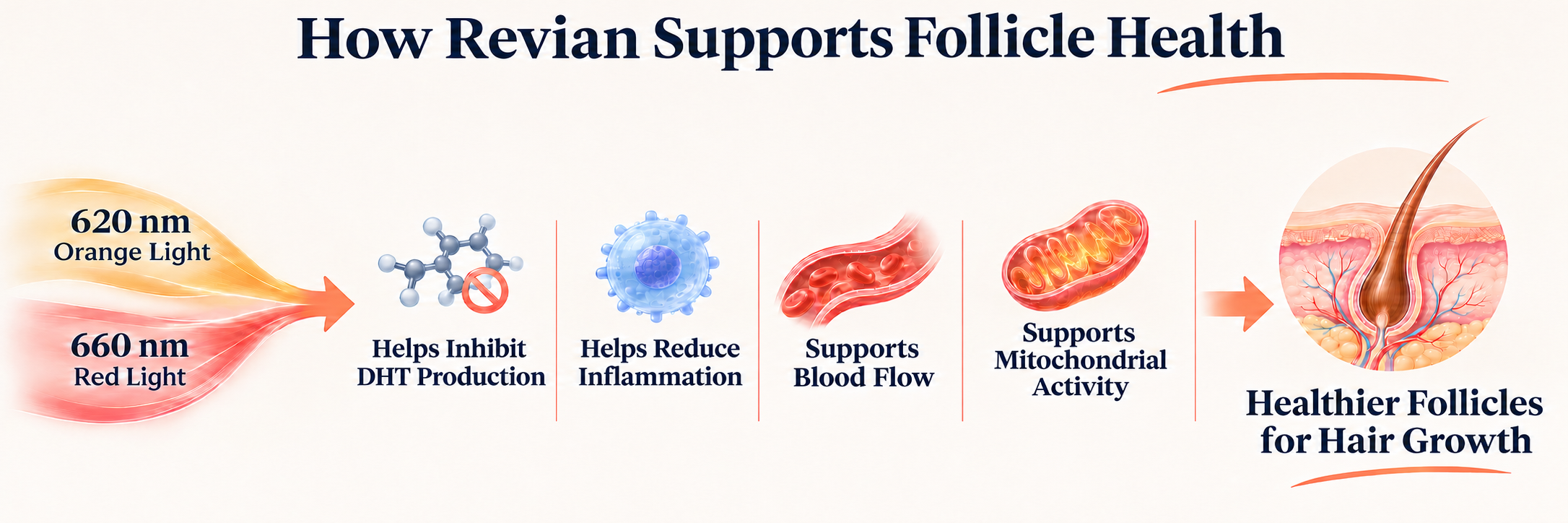
But Revian’s benefits extend beyond inhibiting DHT. In addition to the commonly understood red light therapy benefits of stimulation of mitochondrial activity and cellular energy production, the nitric oxide generated by Revian’s dual-wavelength technology supports microcirculation and helps regulate inflammation, creating a healthier scalp environment for hair growth. 10, 13, 16
“I use this [Revian] red light because I think that the science is better than any other one on the market.”
Kay Durairaj, MD, FACS1
Measurable Growth In Only 16 Weeks
In Revian’s randomized, double-blind clinical trial, participants who used Revian Red at least 80% of the time averaged 26.3 more hairs per cm² at 16 weeks than participants who wore an identical cap that emitted no light.6,7 Those using the placebo cap continued to lose hair over the course of the study.
To put that in perspective, a square centimeter is about the size of your fingernail. And measured similarly in each treatment’s own clinical trial, Revian delivered:
- More than 2x the hair growth of finasteride14
- About 1.6x the hair growth of 5% minoxidil foam over the same 16 weeks15
The trial was published in Dermatologic Surgery in 2025. Sinclair and his coauthors concluded, “The LED caps were well tolerated and increased hair density in patients with AGA.”7
Keep in mind that hereditary hair loss isn’t curable. If you stop using Revian, your hair fall is likely to resume.12 Ten minutes a day is the commitment.
If AGA runs in your family and you’re noticing early changes, get assessed and ask about Revian Red. It’s FDA-cleared for AGA, early research suggests it may act on the DHT pathway, and it has clinical hair-count results behind it.5,6,10
Explore Revian Red clinical results
Frequently Asked Questions
Does hair loss in my family mean I will lose my hair?
No. Family history raises susceptibility, but it can’t predict exactly whether or when you’ll develop pattern hair loss. Genes from either side of the family can contribute.2,3
Should I wait until I can see thinning to act?
No. Follicles can miniaturize before thinning is obvious, and a visible scalp can mean density is already down by half.4,8If you have a strong family history or notice less volume, ask a dermatologist for a baseline assessment.
Is Revian FDA-cleared for hereditary hair loss, and does it target DHT?
Revian Red is FDA-cleared to treat AGA, the most common form of hereditary hair loss, and promote hair growth.5 In a laboratory study, its dual wavelengths reduced DHT production by 79%, compared with about 40% for finasteride.10
How long does Revian take to show results?
Revian’s clinical trial measured hair counts at 16 weeks in participants who used the device at least 80% of the time.6,7Use it consistently for 10 minutes a day and review your progress with your clinician.
Can I share my Revian Red device with my partner?
Yes! Revian Red can be shared between partners or family members. Each person simply completes their own 10-minute daily treatment. As facial plastic surgeon Dr. Kay Durairaj explained during the webinar, she and her husband share their Revian cap.¹
Sources:
- Revian. Webinar featuring Kay Durairaj, MD, FACS, and Jordan R. Plews, PhD. Transcript supplied by Revian, 2026. Watch Webinar
- Yip L, Rufaut N, Sinclair R. Role of genetics and sex steroid hormones in male androgenetic alopecia and female pattern hair loss. Australas J Dermatol. 2011;52(2):81–88. Read source
- International Society of Hair Restoration Surgery. Androgenetic Alopecia: A Guide to Pattern Hair Loss. Read source
- Minta A, Rose L, Kobayashi S, Dulmage B. Diagnostic Evaluation of Hair Loss: A Narrative Review. EMJ Dermatol. 2023. doi:10.33590/emjdermatol/10302576. Read source
- U.S. Food and Drug Administration. Revian Red 510(k) K173729. Indications for use and device description. Read source
- Revian. Clinical Results: Primary Endpoint, Target Area Hair Counts at Week 16. ClinicalTrials.gov: NCT04019795. Read source
Primary Endpoint: Target Area Hair Counts at Week 16. Mean results for the Efficacy Evaluable Population of trial participants who completed all 16 weeks, had no major protocol violations, and were at least 80% compliant with the treatment regimen. - Thomas M, Stockslager M, Oakley J, Womble TM, Sinclair R. Clinical Safety and Efficacy of Dual Wavelength Low-Level Light Therapy in Androgenetic Alopecia: A Double-Blind Randomized Controlled Study. Dermatol Surg. 2025;51(4):416–421. doi:10.1097/DSS.0000000000004509. Read source
- Sinclair R, Torkamani N, Jones L. Androgenetic alopecia: new insights into the pathogenesis and mechanism of hair loss. F1000Research. 2015;4:585. Read source
- Dinh QQ, Sinclair R. Female pattern hair loss: current treatment concepts. Clin Interv Aging. 2007;2(2):189–199. Read source
- Kocher J, Jandick N, Spragion D, DeSena PJ Jr, Womble TM, Crizer K, Stasko N. Dual Wavelength LEDs Induce Reactive Oxygen Species and Nitric Oxide That Inhibit the Production of Dihydrotestosterone by 5-α Reductase. J Biophotonics. doi:10.1002/jbio.202400388. Read source
- Rathnayake D, Sinclair R. Male androgenetic alopecia. Expert Opin Pharmacother. 2010;11(8):1295–1304. Read source
- Revian. What happens if I discontinue use of Revian? Read source
- Vanaria RJ, Chaudry A, Nestor MS. The Use of Light-Based Therapies in the Treatment of Alopecia. J Cosmet Dermatol. 2025. doi:10.1111/jocd.70434. Read source
- Leyden J, Dunlap F, Miller B, et al. Finasteride in the treatment of men with frontal male pattern hair loss. J Am Acad Dermatol. 1999;40(6):930–937. Read source
- Olsen EA, Whiting D, Bergfeld W, et al. A multicenter, randomized, placebo-controlled, double-blind clinical trial of a novel formulation of 5% minoxidil topical foam versus placebo in the treatment of androgenetic alopecia in men. J Am Acad Dermatol. 2007;57(5):767–774. Read source
- Förstermann U, Sessa WC. Nitric oxide synthases: regulation and function. European Heart Journal. 2012;33(7):829–837. doi:10.1093/eurheartj/ehr304. Read source
No head-to-head trials were conducted. Comparisons are drawn from each treatment’s separate published trial data; the finasteride and minoxidil trials enrolled men only.
Research disclosure: The 2025 clinical publication includes authors affiliated with emitBio and KNOW Bio. The laboratory study was conducted by authors affiliated with Revian and KNOW Bio, with potential ownership interests disclosed in the publication.
