Beyond Minoxidil and Finasteride: Where Light Therapy Fits in a Hair Loss Treatment Plan

August 20, 2026
Author Dr. Jordan R. Plews
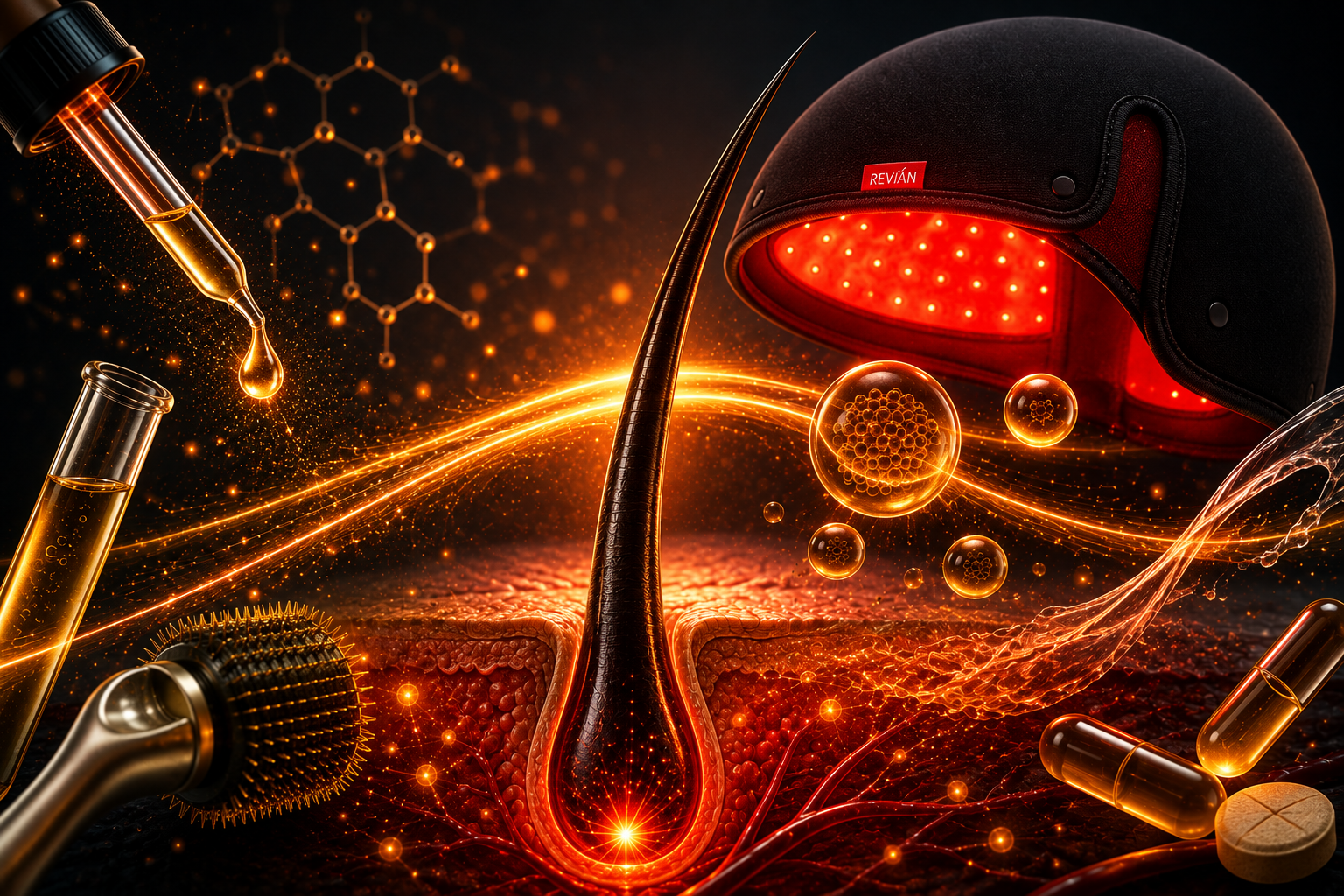
Hair loss often requires more than one treatment because no single therapy addresses every factor involved in hair growth and follicle miniaturization. For people with androgenetic alopecia (AGA), a comprehensive plan may include minoxidil, finasteride, exosomes, platelet-rich plasma (PRP), microneedling, hair transplantation (FUE or FUT), and low-level light therapy (LLLT), also called photobiomodulation (PBM). Rather than viewing these treatments as competitors, the goal is to build the right treatment regimen. Revian is the only hair growth device that provides a noninvasive, at-home dual-wavelength LED treatment to that regimen, supported by FDA cleared clinical evidence demonstrating proven hair regrowth in AGA and separate mechanistic research showing an effect on the DHT pathway.
Why Hair Loss Often Requires a Combination Approach
When people search for the best hair-loss treatment, the natural instinct is to look for one answer: medication (e.g. minoxidil or finasteride), PRP, microneedling, or hair transplantation. However, these treatments are not an either/or decision. AGA involves progressive follicular miniaturization and can be influenced by Dihydrotestosterone (DHT), genetics, nutrition, inflammation and other factors. Because different treatments act through different mechanisms, clinicians may combine modalities rather than relying on one treatment to do everything.
“There is a growing trend to use multimodal treatments for hair loss.” – Trisha Khanna, MD
Related physician interview: Treating Hair Loss: A Multimodal Approach with Dr. Trisha Khanna
Think Treatment Stack, Not Treatment Winner
A useful way to think about hair restoration is as a treatment stack. Each component has a different role, and adding one modality does not automatically mean stopping another. The right combination depends on the diagnosis, stage of hair loss, goals, contraindications and guidance from a qualified healthcare professional.
Available Treatment Options
- Minoxidil (Rogaine): Supports hair growth and the growth phase.
- Finasteride (Propecia): Systemically inhibits 5-alpha reductase and reduces DHT.
- Revian (LLLT / PBM): Non-invasive light-based at home treatment that is proven to inhibit DHT, reduce inflammation, and improve blood flow, and is FDA cleared to regrow hair.
- PRP: Platelet-derived growth factors, patients often report treatments are painful.
- Biologics / Regenerative therapies (exosomes, secretomes): Emerging adjunctive therapy supports regenerative cell signaling that may be layered into a multimodal hair-restoration regimen.
- Microneedling: Controlled micro-injury and wound-healing signaling, often used as an adjunct, including PRP and biologics.
- FUE / FUT hair transplant: Surgical redistribution of follicles to restore hair surgically, usually combined with other supporting treatments
- Nutritional Supplements: Using vitamins and minerals to support follicular health from the inside out.
LED Light therapy is particularly relevant to a treatment stack because it is noninvasive, at home and distinct from medication, injections and surgery. Someone using minoxidil does not necessarily have to choose between minoxidil and light therapy. The same principle applies to finasteride, PRP, biologics, microneedling, and FUE or FUT hair transplantation: light therapy can be discussed as another component of the broader plan.
What Physicians Say About Combining Treatments
Dr. Khanna specifically gives topical minoxidil plus a light cap as an example of multimodal treatment and discusses LLLT alongside oral medications, PRP and hair transplantation. Kay Durairaj, MD, FACS, also discusses hair restoration as a multimodality process in Revian educational content, including approaches that combine microneedling, supplements and red-light therapy. In Modern Aesthetics, Dr. Durairaj and I describe PBM as a nonpharmacologic approach that may serve as an adjunct around regenerative treatments such as PRP and microneedling. Dermatologist Dina Strachan, MD, likewise emphasizes diagnosis first when evaluating at-home hair-growth caps and discusses Revian Red as a dual-wavelength LED option.
Watch: The Science of Dual-Wavelength Photobiomodulation Webinar with Dr. Kay Durairaj
Read: The Science of Dual-Wavelength Photobiomodulation, Modern Aesthetics
Independent physician resource: Dermatologist Recommended Hair Growth Caps, Dina Strachan, MD
Why Revian Belongs in the Stack
Not all light-based hair-growth devices are the same. Rather than focusing on whether a device uses lasers or LEDs, consumers should consider its wavelengths, scalp coverage, treatment protocol, FDA clearance and, most importantly, device-specific clinical evidence.
Learn more: See Revian research comparing LED and lasers
Revian RED uses dual-wavelength 620 nm + 660 nm LED light. Laboratory research found that this combination inhibited 5-alpha reductase and reduced DHT production by 79% in vitro, providing mechanistic evidence for how Revian may influence a key pathway in androgenetic alopecia.
More importantly, Revian has randomized clinical evidence demonstrating hair growth. In a prospective, randomized, double-blind, placebo-controlled study, compliant participants achieved an increase of 26.3 hairs/cm² at 16 weeks compared with placebo, with no device-related serious adverse events reported.
Explore: How Revian dual-wavelength photobiomodulation works | Revian clinical results
The Bottom Line: Don’t Think Either/Or, Think Combination.
Hair restoration is rarely about choosing one treatment and rejecting everything else. Minoxidil, finasteride, PRP, microneedling, FUE/FUT hair transplantation and photobiomodulation occupy different places in the hair-restoration toolbox. For appropriate patients, Revian RED adds an evidence-backed, noninvasive, at-home dual-wavelength LED modality to that toolbox. Its value is not that it must replace the rest of the treatment plan. Its value is that it can be considered as part of the plan.
The goal is not to find one treatment that does everything. The goal is to build the right hair-restoration regimen, and light therapy deserves a place in that conversation.
Trademark Notice: Rogaine® is a registered trademark of Kenvue Inc. Propecia® is a registered trademark of N.V. Organon. All other trademarks are the property of their respective owners. Use of these trademarks is for identification purposes only and does not imply endorsement or affiliation.