LED vs. Laser Caps: What the Physics (and the Data) Actually Say

August 28, 2026
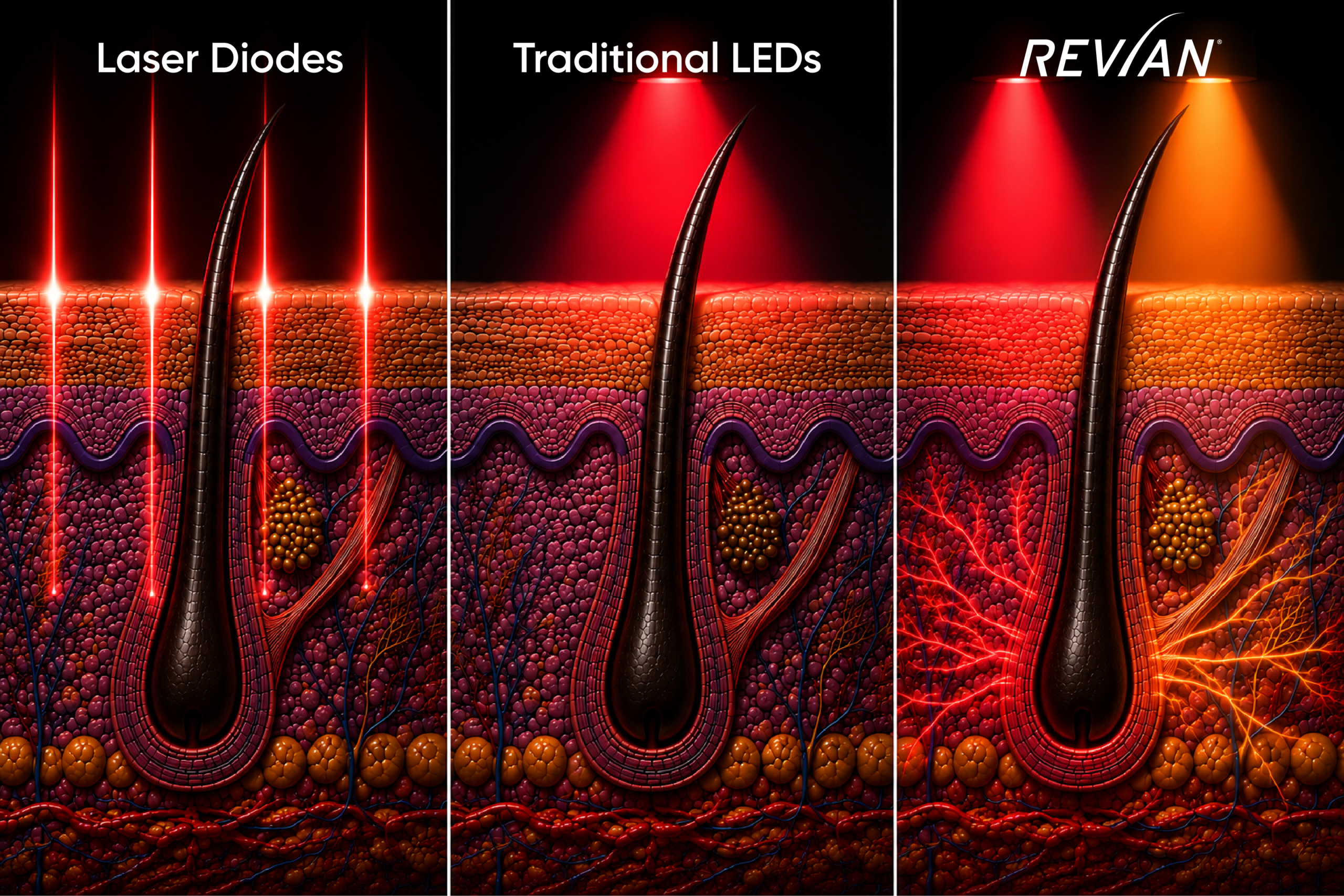
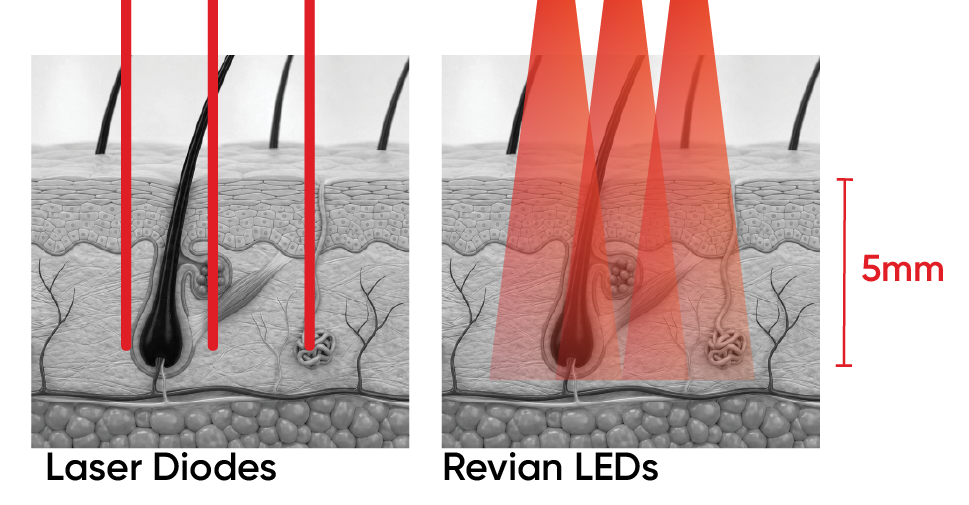
Coverage. Laser diodes emit narrow, point-source beams, creating gaps between emitters. LEDs emit a wider beam pattern for more uniform coverage from fewer components.
Author Tracy Geisler
Most at-home hair growth devices fall into one of two camps: laser diode caps and LED caps. Here’s what actually differs between the two, and why it matters for your scalp.
The Core Difference
Both fall under low-level light therapy, but they deliver light very differently. A 2025 review in the Journal of Cosmetic Dermatology (Vanaria, Chaudry, Nestor) entitled “LED Therapy in Treating Androgenetic Alopecia”, looked at 63 articles on light-based alopecia therapies, highlights three practical differences:
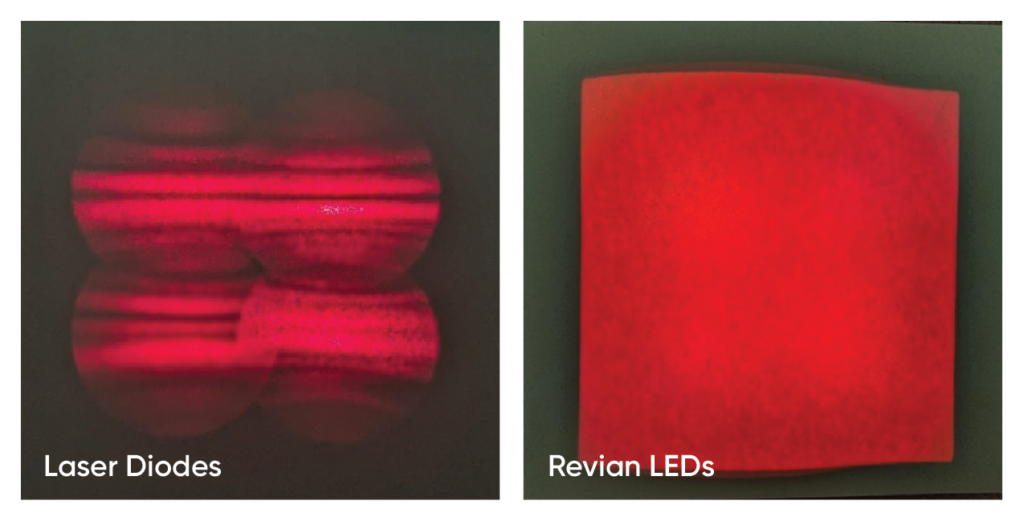
Coverage. Laser diodes emit narrow, point-source beams, creating gaps between emitters. LEDs emit a wider beam pattern for more uniform coverage from fewer components.
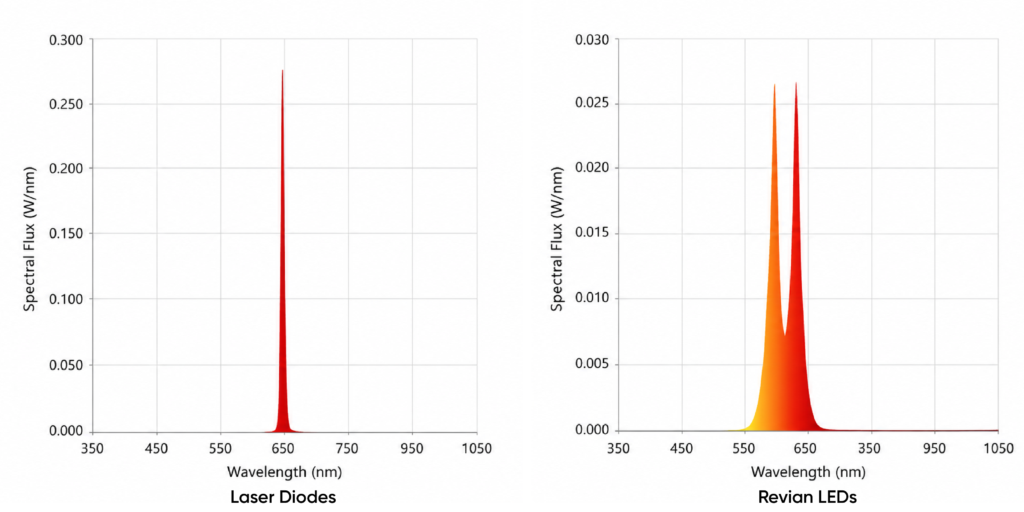
Spectral width. Laser diodes produce an extremely narrow wavelength band (~2.5nm FWHM). Revian’s dual-wavelength LED system produces a much broader combined light emission (~27.7nm FWHM), giving more opportunities to activate the relevant photoreceptors increasing the stimulation of mitochondria and the release of NO.
Skin penetration. Independent testing found Revian’s LEDs transmit light through 4 to 5mm of skin, the depth of the dermal papilla, at 17.1 to 18.4%, versus 15.0 to 15.8% for market-leading laser caps: delivering roughly 16% more effective energy to the base of the follicle.
Why “Laser” Doesn’t Mean “Better”
The goal of photobiomodulation isn’t maximum heat or power. It’s delivering the right wavelengths, at the right dose, with consistent coverage. Laser systems also generally run hotter and draw more power, while LEDs, including Revian Red with onboard thermal regulation, generate less heat in a comparable treatment area.
LEDs also offer an important advantage in wavelength selection. Most laser caps are built around a single wavelength near 650 nm, while LEDs can be engineered to deliver combinations that aren’t practical with laser diodes, including Revian’s patented 620 nm + 660 nm pairing.
As Kay Durairaj, MD, FACS, and Jordan R. Plews, PhD, explain in Modern Aesthetics, “only LEDs can practically deliver the dual-wavelength (620 + 660 nm) architecture” used to produce these distinct biologic effects.
That distinction matters because the two wavelengths aren’t simply redundant sources of red light. In Modern Aesthetics, Durairaj and Plews describe evidence that combining 620 nm and 660 nm influences cellular signaling tied to circulation, inflammation, and androgen activity. In other words, the more meaningful question is not simply whether a device uses an LED or a laser, but whether it delivers the wavelengths, dose, and coverage needed to produce the intended biological effect.
Other Things To Consider
- When comparing at-home light therapy devices, look beyond whether the marketing says “laser” or “LED.” Consider:
- Which specific wavelengths does the FDA clearance cover?
- Did you know you can look up any devices 510k? All you need to do is visit the FDA site and enter the company or device name and search!
- There are many companies promoting they have dual wavelength, but they only have clearance on one wavelength. Check out some examples:
- Capillus trispectrum 312 (claims 3 wavelengths but only has FDA clearance on 650 nm wavelength): https://www.accessdata.fda.gov/cdrh_docs/pdf16/K163170.pdf
- Kiierr dual wavelength (claims 2 wavelengths but only has FDA clearance on 650 nm wavelength): https://www.accessdata.fda.gov/cdrh_docs/pdf18/K181878.pdf
- If the specific device you’re considering isn’t covered by an active FDA clearance, it has been proven to be safe or effective.
- Coverage and convenience features, such as how much does it weigh, does it have to be plugged in during treatments and how much coverage does it offer.
- Are there studies or clinical data on the device you are thinking of buying?
- Look for peer-reviewed research and/or studies conducted on the specific device.
The Bottom Line
LED vs. laser isn’t the most important question. Wavelength, coverage, penetration, dose, and clinical evidence are what ultimately determine the quality of a photobiomodulation device.
“Laser” doesn’t automatically mean stronger or more clinically validated. Ask what wavelengths the device actually delivers, whether those wavelengths are included in its FDA clearance, and whether the device itself has been studied in a well-controlled clinical trial.
Click To Learn More About Revian’s Clinical Research
Sources:
- Vanaria RJ, Chaudry A, Nestor MS. “LED Therapy in Treating Androgenetic Alopecia.” Journal of Cosmetic Dermatology. 2025;24(9):e70434.
- Plews JR, Durairaj K. “The Science of Dual-Wavelength Photobiomodulation.” Modern Aesthetics. May/June 2026.
- Kocher J, Jones N, Stallings D, et al. “Dual Wavelength LEDs Induce Reactive Oxygen Species and Nitric Oxide That Inhibit the Production of Dihydrotestosterone by 5-α Reductase.” Journal of Biophotonics. 2025.
- Thomas M, Stockslager M, Oakley J, Womble TM, Sinclair R. “Clinical Safety and Efficacy of Dual Wavelength Low-Level Light Therapy in Androgenetic Alopecia: A Double-Blind Randomized Controlled Study.” Dermatologic Surgery. 2025;51(4):416-421.
- Ash C, et al. Lasers in Medical Science. 2017;32:1909-1918.
- FDA 510(k) K163170 (Capillus) and K181878 (Kiierr), as cited in the original blog draft.