
The Nitric Oxide-DHT Connection: Why Two Wavelengths Matter for Hair Growth

September 3, 2026
Author Jacob Kocher, PhD
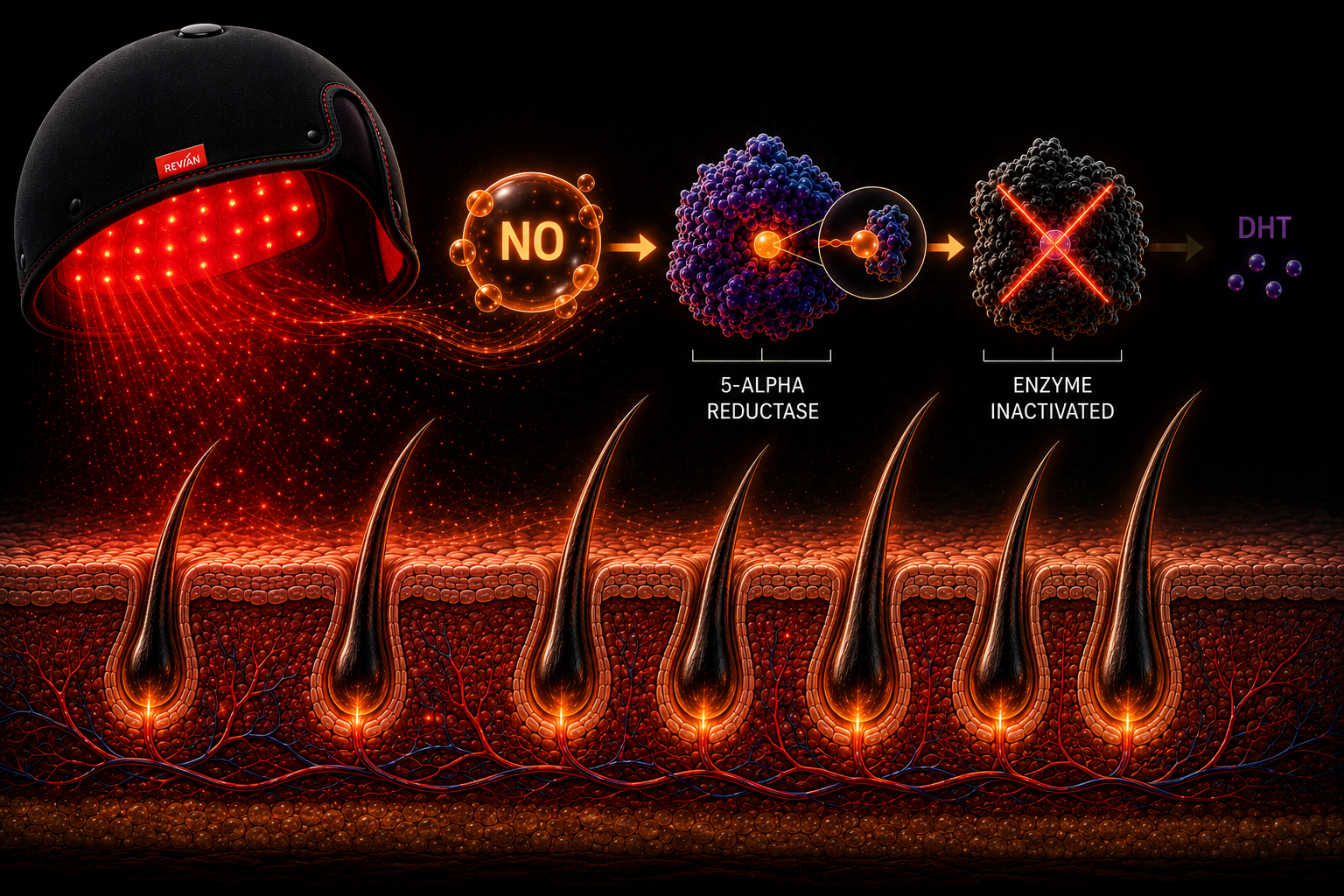
Most explanations of light therapy for hair loss stop at blood flow and inflammation. But the biology may go much deeper. Research shows that specific combinations of light wavelengths can influence the pathway that produces DHT itself, using nitric oxide, a signaling molecule the body already makes.
The Enzyme at the Center of Hair Loss
DHT is a primary driver of androgenetic alopecia, causing susceptible follicles to shrink, spend less time growing, and produce progressively finer hair. At the center of this process is one key enzyme: 5-alpha reductase. Its job is to convert testosterone into DHT, making it a critical target for treatments designed to interrupt the DHT pathway.
Where Nitric Oxide Comes In
A peer-reviewed study in the Journal of Biophotonics found that combining 620 nm orange and 660 nm red light stimulates nitric oxide (NO) production. NO then binds to a critical thiol group within 5-alpha reductase, inactivating the enzyme responsible for converting testosterone into DHT. In other words, dual-wavelength light doesn’t just improve the environment around the follicle. In other words, dual-wavelength light doesn’t just support the follicle. It triggers a biological signaling pathway that targets the enzyme responsible for making DHT.
Read About the Journal of Biophotonics Study
Why the Dual Wavelength Matters
Most hair-growth light devices rely on a single red wavelength around 650–660 nm. Revian doesn’t. And the difference matters.
In cellular testing, neither wavelength alone significantly increased nitric oxide. Together is where the synergy happened, producing a dramatic NO response. Even more compelling, 24 hours after exposure, the NO-producing response remained significantly elevated.
That’s what conventional single-wavelength devices are missing. Revian’s patented 620 + 660 nm combination doesn’t simply deliver more light. It creates a biological response that neither wavelength produced alone, activating the nitric oxide pathway linked to 5-alpha reductase inhibition and reduced DHT synthesis.
What This Means for DHT Levels
In controlled laboratory testing, Revian’s dual-wavelength light therapy reduced DHT conversion by 79%, compared with approximately 38% for finasteride under the same experimental conditions. These findings demonstrate the potential of Revian’s nitric oxide-driven mechanism to meaningfully influence the DHT pathway associated with hair follicle miniaturization.
The Bottom Line
- NO targets DHT at its source. It inhibits 5-alpha reductase, the enzyme that converts testosterone to DHT.
- Two wavelengths do what one can’t. Neither 620 nm nor 660 nm alone significantly increased NO in the cellular testing. Together, they produced a synergistic increase in nitric oxide.
- The impact on DHT was substantial. In controlled laboratory testing, the dual-wavelength mechanism reduced DHT conversion by 79%, compared with approximately 38% for finasteride under the same experimental conditions.
- The response doesn’t stop when the light turns off. The study found elevated iNOS expression 24 hours after dual-wavelength exposure, suggesting continued cellular NO production after treatment.
Sources: