
GLP-1s and Hair Loss: What’s Actually Happening, and What You Can Do

October 9, 2026
Featuring: Dr. Kay Durairaj
GLP-1 medications such as semaglutide and tirzepatide have been associated with increased hair shedding, particularly during rapid weight loss. Research suggests this is often telogen effluvium, triggered by factors such as reduced calorie and protein intake, nutritional deficiencies and physiological stress. In some people, weight loss may also reveal underlying androgenetic alopecia. Understanding the cause is key to supporting healthier hair growth.
GLP-1 Hair Loss Is Becoming More Common
If you’ve started semaglutide (Ozempic®, Wegovy®) or tirzepatide (Mounjaro®, Zepbound®) and noticed more hair in your brush, you’re not alone.
Hair loss isn’t an official listed side effect of every GLP-1 medication, but research is catching up to observations of patients and clinicians have been observing. And according to facial plastic surgeon and hair restoration expert Dr. Kay Durairaj of Beauty By Dr. Kay it has become an increasingly common concern among patients using GLP-1 medications, as she explains:
“I have seen so much GLP-1-mediated hair loss, and patients are dropping the use of their GLP because of hair thinning,” Dr. Durairaj explains.
Understanding why shedding may occur is important because the medication itself may not be the whole story and there are preventative steps that can be taken to mitigate the risk of hair loss in conjunction with GLP-1 use.
What The Research Shows
A 2026 systematic review in Science Progress (Gupta et al.) analyzed 24 studies and found GLP-1 receptor agonists, especially semaglutide and tirzepatide, are linked to non-scarring hair loss, mostly telogen effluvium and, in some cases, the unmasking of underlying androgenetic alopecia (AGA). The effects were dose-dependent, more pronounced with greater weight loss, and disproportionately reported by women.
While other weight loss medications including SGLT-2 and DPP-4 innhibitors may be linked to hair loss, a University of Pennsylvania study reported that GLP-1 patients were 37% more likely to be diagnosed with hair loss than SGLT-2 inhibitor users and 68% more likely than DPP-4 inhibitor users. Zepbound® trial data reinforces this proportionately larger impact of GLP-1s on hair loss, with hair loss being reported in 7.1% of female patients compared with 1.3% in the placebo group.
A newer cross-sectional study published in Skin Appendage Disorders (Alharbi and Alkhalifah, 2026) found an even stronger signal in real-world use. Among 152 users with no prior hair loss, 70.4% reported shedding after beginning treatment, approximately ten times the 3% to 7% rates reported in registration trials.
Among patients who lost 15% or more of their body weight, reported shedding increased to 82.7%.
Importantly, the magnitude of weight loss, rather than the specific drug used, was the strongest predictor for hair loss. The apparent stronger statistical association with tirzepatide use disappeared after researchers accounted for the amount of weight lost. However, because this was a self-reported survey, rather than a randomized clinical trial, the exact percentages should be viewed as directional and not definitive.
Why Can Hair Loss Happen With GLP-1s?
One of the leading explanations is that rapid weight loss, reduced caloric intake and changes in nutrition may create physiological stress that affects the normal hair-growth cycle. This means that the medication isn’t necessarily acting directly on the hair follicle.
Dr. Kay sees this frequently in her own patients, observing:
“Appetites are gone, and people just are forcing themselves to eat. The protein intake has dropped drastically, and hair requires protein, it requires iron, and it requires vitamin D to grow. These are the top three things that I’m seeing deficiencies in with our GLP patients, and these things really drastically impact hair growth.”
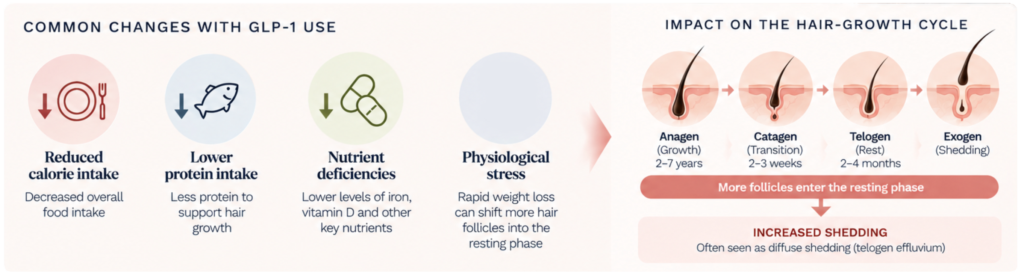
In this way, rapid weight loss and nutritional changes can contribute to telogen effluvium, a form of diffuse shedding that occurs when physiological stress causes a larger-than-normal number of follicles to transition into the resting phase of the hair cycle. As Dr. Kay summarizes:
“GLP-1, in a way, is a form of nutritional stress, and that really accelerates what they’ve already been going through.”
Why A Healthy Scalp Environment Matters
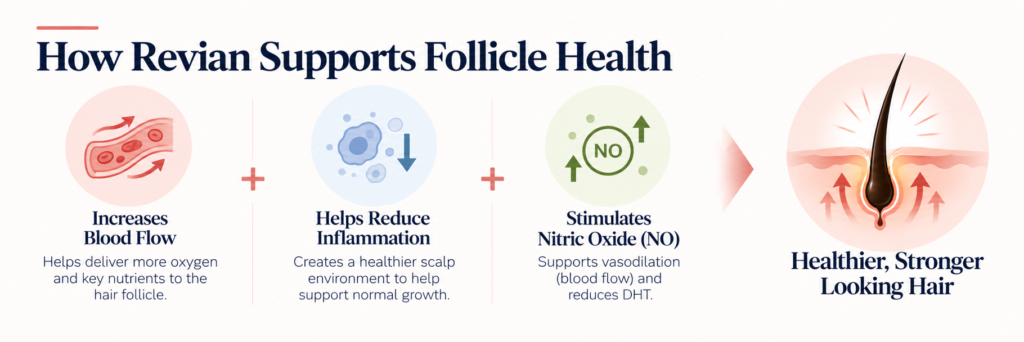
While nutrition and rapid weight loss can play important roles in GLP-1-associated hair shedding, healthy hair growth also depends on the biological environment of the scalp. Hair follicles are metabolically active structures that depend on oxygen, nutrients, cellular energy, and normal biological signaling. Circulation, inflammatory regulation, and follicular activity are therefore relevant to maintaining a healthy scalp environment, which is where Revian’s patented dual-wavelength technology comes into play. Revian’s proprietary 620 nm and 660 nm LED light combination targets multiple biological processes associated with hair growth, including nitric oxide production, vasodilation, cellular energy levels, and inflammatory regulation.
GLP-1s May Not Be the Only Factor
Not every patient who experiences shedding while taking a GLP-1 medication has the same underlying cause. As previously explained, for many patients, rapid weight loss or nutritional changes may trigger temporary telogen effluvium. For others, that stress may expose or accelerate an underlying tendency toward androgenetic alopecia, which is commonly referred to as male or female pattern hair loss. In some individuals, other conditions may also be contributing, including inflammatory scalp disorders such as central centrifugal cicatricial alopecia (CCCA), a form of scarring hair loss, or autoimmune conditions that affect hair growth. In many cases, multiple factors contribute to hair loss, making it important to understand and address the underlying causes.

This means that hormonal changes, menopause or perimenopause, postpartum bodily changes, stress, nutritional deficiencies and genetic hair loss may already be perceptibly or imperceptibly affecting the follicle before GLP-1 therapy begins. Thus, simply assuming that “the GLP-1 is causing my hair loss” may overlook other contributing factors.
Dr. Kay emphasizes the importance of looking deeper, particularly at nutritional status and iron stores:
“You just cannot grow hair when you have no iron stores,” she explains. “I think doing a full screening, biomarker testing, blood level testing is really critical.”
Key Takeaways
In summary, telogen effluvium typically causes more diffuse shedding after a physical or nutritional stressor. Androgenetic alopecia more often appears as progressive pattern thinning, such as a widening part or thinning at the crown or temples. The two can occur concurrently, and a dermatologist or qualified hair-loss specialist may help to determine which factors are contributing and how to mitigate their impacts.
What Can You Do About GLP-1-Associated Hair Loss?
The first step is understanding what type of hair loss, or combination of hair loss types, you’re actually experiencing.
Talk with the healthcare provider prescribing your GLP-1 medication and consider consulting a dermatologist or hair-loss specialist to receive a medical diagnosis and treatment plan; rather than stopping your weight loss treatment or attempting to address the shedding on your own.
Depending on the individual, a medical evaluation is likely to be detailed and may include examining nutritional intake, iron or ferritin status, vitamin levels, hormonal factors and signs of underlying androgenetic alopecia. If it is determined that GLP-1-associated shedding has uncovered an underlying hair-loss condition, addressing that condition may require a customized plan that includes treatments that can only be performed in a medical office or prescriptions.
Where Does Revian Fit?
Revian RED is frequently included in treatment plans for hair loss that is concurrent with GLP-1 usage as its patented dual-wavelength technology helps create a healthier scalp environment by targeting biological processes important to healthy hair growth; including nitric oxide production, circulation, cellular activity, and inflammatory regulation.
Revian’s technology is supported by published clinical research demonstrating industry-leading hair growth results, including a 26.3 hairs/cm² improvement versus placebo after just 16 weeks. More recently, research has demonstrated Revian’s ability to mitigate dihydrotestosterone or DHT, the hormone primarily responsible for androgenetic alopecia. Additional research involving women with central centrifugal cicatricial alopecia (CCCA), an inflammatory form of hair loss, reported improvements in both hair density and inflammatory signs after using the Revian Red device.
Revian’s clinical research also extends to scalp health. In a randomized, sham-controlled study involving 81 participants, Revian RED demonstrated statistically significant improvements in scalp itching and burning or stinging after 16 weeks. Nearly 78% of Revian users reported rarely or never experiencing scalp itching, compared with 44% of those using the sham device.For individuals experiencing hair shedding while taking GLP-1 medications, scalp health is an important consideration in a comprehensive approach to hair restoration. Addressing nutritional deficiencies and other underlying causes of shedding remains essential, while supporting a healthy follicular environment is an important part of maintaining overall hair health.
The Bottom Line
GLP-1-associated hair shedding is becoming an increasingly important concern as more people use these medications for weight management. Rapid weight loss, nutritional deficiencies, and physiological stress can disrupt the normal hair-growth cycle, while also revealing underlying hair-loss conditions.
The good news is that hair shedding doesn’t necessarily mean permanent hair loss or that GLP-1 treatment needs to be discontinued. Understanding the underlying causes and taking a proactive approach to hair health can make a meaningful difference.
As Dr. Kay emphasizes, maintaining adequate protein intake, addressing nutritional deficiencies, and evaluating other contributing factors are essential steps. But nutrition is only part of the equation. Addressing other underlying causes, such as DHTupporting a healthy scalp environment, including circulation, cellular activity, and inflammatory regulation, is also important for healthy hair growth.
Revian’s clinically studied dual-wavelength technology helps create a healthier environment for hair follicles by targeting these biological processes. Combined with appropriate nutritional support and medical guidance, focusing on both internal health and the scalp environment provides a more comprehensive approach to hair restoration.
If you’re experiencing hair shedding while taking a GLP-1 medication, consult your healthcare provider before changing your medication or beginning treatment. This article is for educational purposes and is not intended as medical advice.
Frequently Asked Questions
Can GLP-1s cause hair loss?
Increased shedding has been reported with GLP-1 use, particularly with significant or rapid weight loss.
Why does it happen?
While still being researched, rapid weight loss, reduced calorie and protein intake, nutritional changes and physiological stress are believed to contribute.
Is GLP-1 hair loss permanent?
Telogen effluvium is generally temporary, but underlying androgenetic alopecia may require treatment.
Should you stop your GLP-1?
Do not stop a prescribed medication because of shedding without discussing it with your healthcare provider.
Can Revian help?
Revian RED’s patented dual-wavelength technology helps create a healthier scalp environment by supporting nitric oxide production, circulation, cellular activity, and inflammatory regulation. These biological processes are important for healthy hair growth, making Revian a valuable consideration as part of a comprehensive approach to hair restoration.
Sources:
- Dr. Kay Durairaj and Dr. Jordan R. Plews. REVIAN educational webinar: “The Science of Dual-Wavelength Photobiomodulation.” Watch the Webinar.
- REVIAN. Dual-wavelength LED Therapy & DHT Inhibition: research summary and supporting data. View source
- Kocher J, et al. “Dual Wavelength LEDs Induce Reactive Oxygen Species and Nitric Oxide That Inhibit the Production of Dihydrotestosterone by 5-α Reductase.” Journal of Biophotonics (2025). View source
- Low-level light therapy as a novel treatment for central centrifugal cicatricial alopecia: An interventional cohort study. View source
- Clinical Efficacy of an At-Home, 620 and 660 nm Red Light Treatment on Scalp Pruritus and Irritation. View Source
- U.S. FDA. Zepbound® (tirzepatide) Prescribing Information: hair loss data from pooled Studies 1 and 2. View source
- Penn Medicine. “Diabetic GLP-1 use linked to increased hair loss risk” (2026), summarizing the University of Pennsylvania cohort published in The BMJ. View source
- Alharbi S, Alkhalifah A. “Prevalence and Predictors of Hair Shedding among GLP-1 Receptor Agonist Users: A Cross-Sectional Study from Saudi Arabia.” Skin Appendage Disorders (2026). View source
- Gupta AK, Teasell EM, Economopoulos V, Mirmirani P. “GLP-1 therapies and hair loss: A systematic review of current evidence and implications for counseling.” Science Progress (2026). View source
Ozempic® and Wegovy® are registered trademarks of Novo Nordisk A/S. Mounjaro® and Zepbound® are registered trademarks of Eli Lilly and Company. Revian is not affiliated with, sponsored by, or endorsed by either company; these marks are referenced solely to identify the medications discussed.
