Thinning Hair in Perimenopause and Menopause: Why It Happens and What Actually Helps

October 1, 2026
Featuring: Dr. Karen Clark and Dr. Dina Strachan
Menopause can contribute to real, progressive hair loss. As estrogen declines, greater androgen influence can contribute to follicle miniaturization, while changes in the growth cycle and scalp environment can lead to increased shedding and progressively thinner, finer hair. The good news is there are treatment options. From minoxidil and hormone management when appropriate to LED light therapy that targets key pathways involved in follicle health, menopausal hair loss can be addressed from multiple angles. Understanding what’s driving the hair loss is the first step toward choosing the right approach to support healthier growth.
One Patient’s Journey Is The Story Of So Many Women
Her hair started thinning in her early 50s. Over the next five years she did what many women do. She saw a dermatologist, received a diagnosis and tried the recommended treatment. She tried an over-the-counter option too. Neither solved the problem.
When she finally came to board-certified dermatologist Dr. Dina Strachan of Aglow Dermatology in New York, the answer turned out to be one that is common and still too often overlooked: perimenopausal and menopausal hair loss.
Her experience is far from unusual. Karen Clark, MD, a board-certified OB/GYN and North American Menopause Society Certified Menopause Practitioner, notes in Today’s Geriatric Medicine that about two-thirds of women may experience some hair loss or thinning related to menopause. The good news, as both physicians show, is that menopausal hair loss is usually hormonal, it can often be slowed or treated, and it responds best when it is diagnosed accurately and addressed early.
Key Takeaways
- About two-thirds of women may experience some hair loss or thinning related to menopause.
- As estrogen falls, the balance shifts toward androgens. Testosterone is converted to DHT, which can shrink hair follicles over time.
- Not all midlife hair loss is hormonal. Thyroid problems, stress, nutrition, medications and hairstyles should be ruled out first.
- Revian Red, an FDA-cleared, dual-wavelength red-light therapy cap, increased hair density compared with a sham device in a 2025 randomized controlled trial published in Dermatologic Surgery.
- Hormone replacement therapy is not currently indicated for hair loss alone. Starting treatment early and staying consistent matter most.
Why Does Hair Thin During Perimenopause and Menopause?
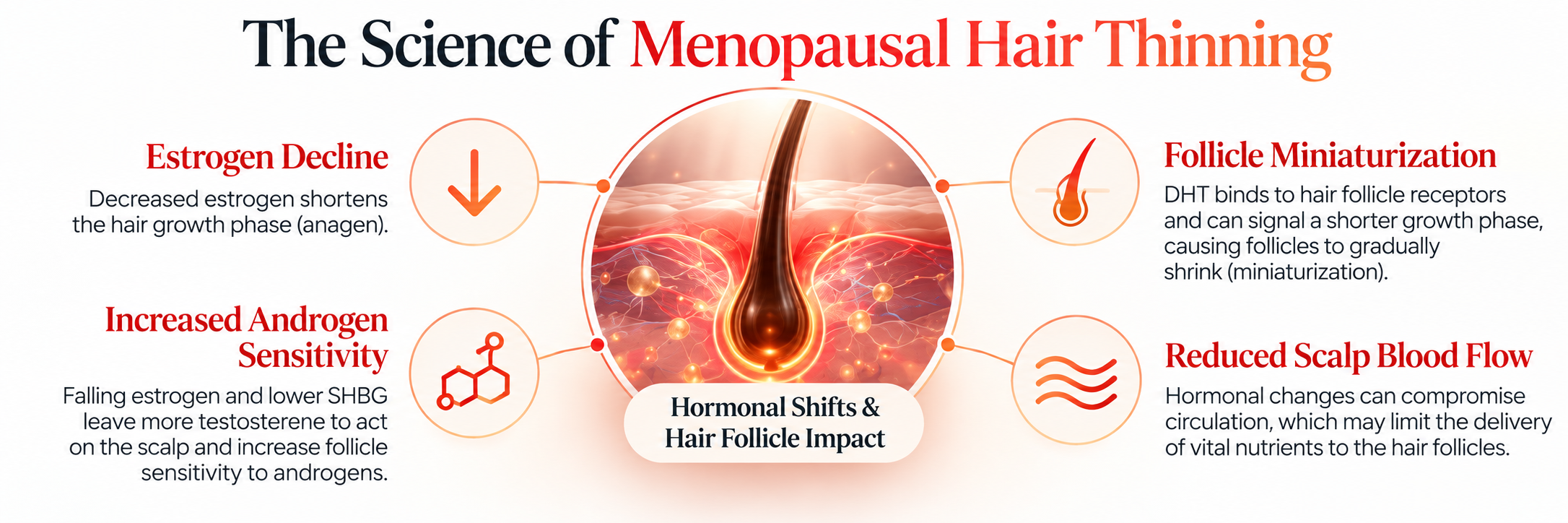
Perimenopause usually begins in a woman’s 40s and can last four to eight years. Menopause begins once a full year has passed since the last period. During this transition, the hormones that have supported a woman’s hair for decades change dramatically.
Estrogen and progesterone support healthy hair growth. As Dr. Clark explains, when they decline, hair grows more slowly and becomes thinner. But the bigger story is the balance between hormones. Women produce testosterone too, and while it declines gradually with age, menopause itself doesn’t lower it. Estrogen, on the other hand, fluctuates during perimenopause and then drops sharply after menopause. According to a 2025 review in Maturitas, that leaves androgens, including testosterone and dihydrotestosterone (DHT), higher relative to estrogen. Falling estrogen also lowers sex hormone-binding globulin (SHBG), a protein that normally keeps testosterone inactive, which frees up more testosterone to act on the scalp.
That is where DHT comes in. Inside the scalp, an enzyme called 5-alpha reductase converts testosterone into DHT, a more potent androgen. DHT binds to androgen receptors in the hair follicle and switches on genes that inhibit hair growth. Over time, affected follicles shrink, a process called miniaturization, and thick hairs are gradually replaced by finer, shorter ones.
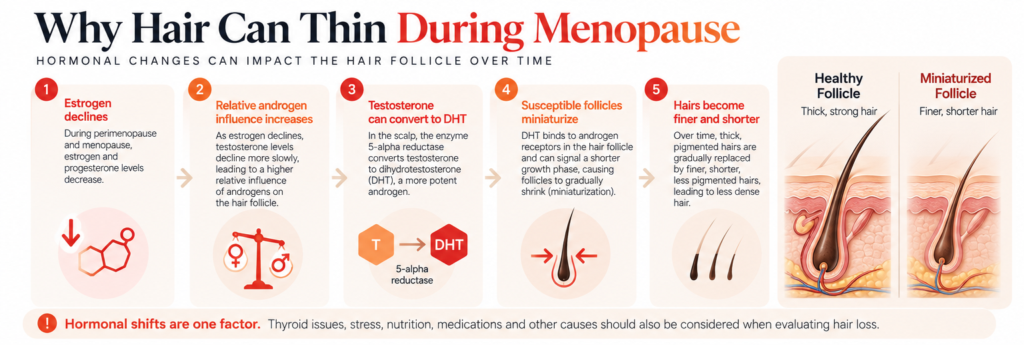
The result is female pattern hair loss, a form of androgenetic alopecia. In women it usually appears as finer, less dense hair rather than bald patches, sometimes with more shedding in the shower or on the brush. Dr. Strachan’s patient fit that picture: thinning at the front of the scalp, a slightly wider part and a family history of hair loss.
Is It Menopause, or Something Else?
Getting to that diagnosis took five years, and her story shows why. She had previously worn locs and twists, styles that can pull on the follicles, and an earlier biopsy led to a diagnosis of traction alopecia. She was treated with steroid injections, with minimal results.
Dr. Clark notes that even at midlife, when hair loss is most often hormonal, other causes have to be ruled out: illness, thyroid problems, poor nutrition, certain medications, stress-related shedding known as telogen effluvium, and conditions such as traction alopecia and alopecia areata. When Dr. Strachan took a fresh look, she found a normal scalp with no visible scarring, hair that was neither brittle nor easily pulled out, and normal blood work. Because the pattern resembled female pattern hair loss but began later in life, she concluded it was perimenopausal hair loss.
That new diagnosis changed the conversation, and it gave her something she hadn’t had in five years: a clear path forward. That matters, because hair loss is rarely just about hair. As Dr. Clark writes, a woman’s hair is closely tied to her identity and self-esteem, and for some women, thinning hair can take a real toll on their self-confidence.
What Treatments Work for Menopausal Hair Loss?
Dr. Strachan walked her patient through the options: minoxidil, nutritional support, platelet-rich plasma (PRP) and red-light therapy. The patient had already stopped topical minoxidil because it irritated her scalp, and she was concerned about unwanted facial hair growth, a known side effect. Those concerns pointed her toward a non-drug option.
Red-Light Therapy with Revian Red
She chose Revian Red, an FDA-cleared, at-home dual-wavelength light therapy cap. It combines 620 nm orange light and 660 nm red light and is used for 10 minutes a day, activated through a mobile app that helps users stay consistent.
Red-light therapy, also called low-level light therapy or photobiomodulation, uses low-intensity light to trigger biological activity in and around the follicle, including increased cellular energy (ATP). Rather than acting on a single target, it addresses several of the factors behind thinning hair at once.
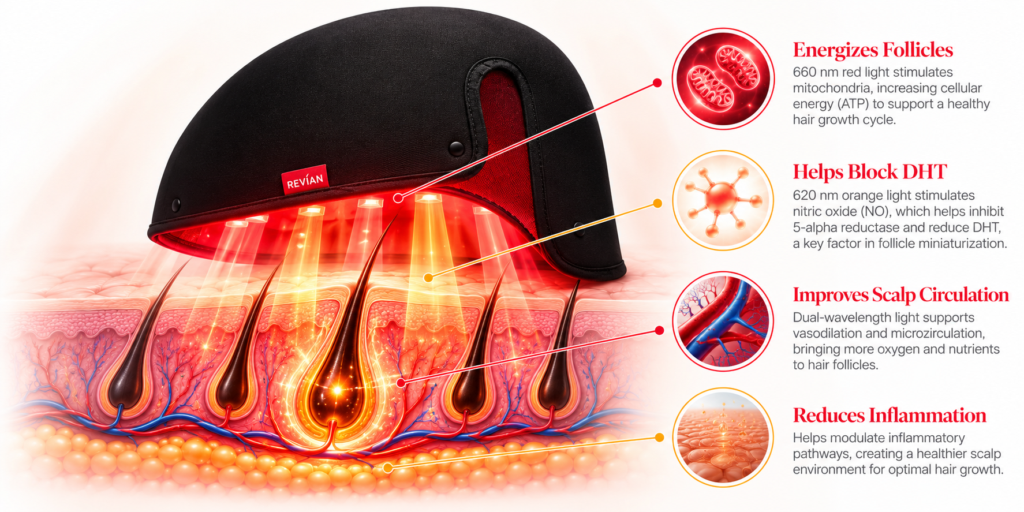
Improved circulation. Nitric oxide helps relax and widen blood vessels, and laboratory research shows Revian’s combination of 620 nm and 660 nm light produces significantly more nitric oxide than either wavelength alone. Better circulation helps deliver oxygen and nutrients to the follicle.
Reduced inflammation. Inflammation plays a role in hair loss, and calming it is one of the ways light therapy is thought to work. In a 2025 study published in the Journal of the American Academy of Dermatology, women with an inflammatory form of hair loss called CCCA used Revian Red daily for six months. Scalp imaging showed fewer signs of inflammation in 61% of participants, and 57% had improved hair density. CCCA differs from menopausal hair loss, but the results point to the cap’s calming effect on the scalp.
Lower DHT. The same study looked directly at the DHT pathway described above. Revian scientists showed that nitric oxide can block 5-alpha reductase, and the dual-wavelength light reduced the conversion of testosterone to DHT by 79% at 24 hours. Neither wavelength alone, nor a 660 nm laser, produced that effect.
Clinically, Revian’s randomized, double-blind, sham-controlled trial, published in Dermatologic Surgery in 2025, enrolled 160 adults with androgenetic alopecia. Among participants who completed 16 weeks of daily use with at least 80% compliance, the pooled treatment groups had 28.5 more hairs per square centimeter than the sham group. Individual treatment arms did not reach significance on their own, and the caps were well tolerated. The trial included both men and women and was not designed specifically for menopausal women.
Medications
Topical minoxidil is the only over-the-counter medication approved in the U.S. for pattern hair loss in women, and a Cochrane review found women using it were more likely to see meaningful regrowth than those on placebo. It takes at least four months to work. Low-dose oral minoxidil and spironolactone are prescribed off-label for female pattern hair loss, and finasteride has mixed evidence in women: a 12-month trial of 137 postmenopausal women found no apparent benefit at 1 mg daily.
Can Hormone Replacement Therapy Help?
It is a natural question, since hormones drive the problem. The current evidence says HRT is not the answer for hair on its own. A 2026 review in Dermatology concluded that HRT is not currently indicated for hair loss alone in menopausal women, and the Maturitas review found estrogen therapy has shown limited efficacy compared with standard hair loss treatments. Women who take HRT for other menopause symptoms should ask their provider how their specific regimen may affect their hair.
Combining Treatments
PRP and nutritional support are also options, and many women get the best results by combining approaches. Dr. Clark notes that a combination of treatments, started as early as possible, gives patients the best chance of success. Read more in our guide, Beyond Minoxidil and Finasteride: Where Light Therapy Fits in a Hair Loss Treatment Plan.
Six Weeks Later
At her six-week follow-up, Dr. Strachan’s patient reported noticing improvement, and her before-and-after photographs documented the change. After five years without progress, the right diagnosis and a non-drug option she could use at home made a visible difference.
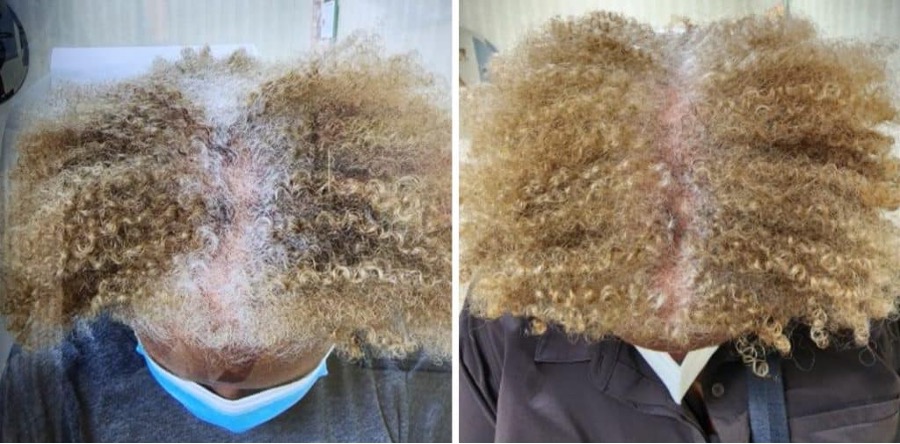
Before and after six weeks of Revian Red use. Photos courtesy of Dr. Dina Strachan, Aglow Dermatology.
Hers is one patient’s experience, and individual results vary. Revian’s clinical trial measured results at 16 weeks, and consistency matters: hair loss is usually ongoing, and treatment generally needs to continue to maintain results. Dr. Clark also encourages patients to see slowing or stopping further loss as a real win, and to steer clear of unproven products sold online.
The lesson from both physicians is the same. Thinning hair does not have to be accepted as an inevitable part of perimenopause and menopause. Women who notice new or progressive hair loss should get a proper diagnosis and ask about their options, including non-drug options like Revian Red.
Frequently Asked Questions
Can menopausal hair loss be prevented?
Not always, since the hormonal changes behind it are a natural part of aging. But it can often be slowed or treated, especially when treatment starts early.
Can women use Revian Red?
Yes. Revian Red is FDA cleared for the treatment of androgenetic alopecia, including female pattern hair loss. Your provider can determine whether it is a good fit for you.
Read the Original Sources
Read Dr. Clark’s Article in Today’s Geriatric Medicine →
Sources:
- Clark K. Light therapy: a promising option for menopausal hair loss. Today’s Geriatric Medicine. 2020;13(2):22. https://www.todaysgeriatricmedicine.com/archive/MA20p22.shtml
- Aglow Dermatology (Dina Strachan, MD). Perimenopausal hair loss case. Posted November 6, 2022. https://www.dinastrachanmd.com/blog/a/general-dermatology/perimenopausal-hair-loss-case/
- Gupta AK, Economopoulos V, Mann A, Wang T, Mirmirani P. Menopause and hair loss in women: exploring the hormonal transition. Maturitas. 2025;198:108378. https://doi.org/10.1016/j.maturitas.2025.108378
- Lee J, Krishnegowda R, Miteva MI. Hormone replacement therapy and hair: a review for trichologists treating menopausal women. Dermatology. 2026. https://doi.org/10.1159/000551153
- Larrondo J, Swain E, Palmer V, Obeime I, Feaster B, Lovell K, Rao S, McMichael A. Low-level light therapy as a novel treatment for central centrifugal cicatricial alopecia: an interventional cohort study. J Am Acad Dermatol. 2025. https://doi.org/10.1016/j.jaad.2025.09.047
- Thomas M, Stockslager M, Oakley J, Womble TM, Sinclair R. Clinical safety and efficacy of dual wavelength low-level light therapy in androgenetic alopecia: a double-blind randomized controlled study. Dermatologic Surgery. 2025;51(4):416-421. https://doi.org/10.1097/DSS.0000000000004509
- Kocher J, Jandick N, Spragion D, DeSena PJ Jr, Womble TM, Crizer K, Stasko N. Dual wavelength LEDs induce reactive oxygen species and nitric oxide that inhibit the production of dihydrotestosterone by 5-α reductase. Journal of Biophotonics. 2025;18(2):e202400388. https://doi.org/10.1002/jbio.202400388